cctv ,epabx,NEC,NEC Sl2100, IP Phone ,

Computer Networking


What is Networking ??


Networking, also known as computer networking, is the practice of transporting and exchanging data between nodes over a shared medium in an information system. Networking comprises not only the design, construction and use of a network, but also the management, maintenance and operation of the network infrastructure, software and policies.
A network connects computers, mobile phones, peripherals, and even IoT devices. Switches, routers, and wireless access points are the essential networking basics. Through them, devices connected to your network can communicate with one another and with other networks, like the Internet.

Computer networking enables devices and endpoints to be connected to each other on a local area network (LAN) or to a larger network, such as the internet or a private wide area network (WAN). This is an essential function for service providers, businesses and consumers worldwide to share resources, use or offer services, and communicate. Networking facilitates everything from telephone calls to text messaging to streaming video to the internet of things.
The level of skill required to operate a network directly correlates to the complexity of a given network. For example, a large enterprise may have thousands of nodes and rigorous security requirements, such as end-to-end encryption, requiring specialized network administrators to oversee the network.

At the other end of the spectrum, a layperson may set up and perform basic troubleshooting for a home Wi-Fi network with a short instruction manual. Both examples constitute computer networking.

Types of networking : - 

There are two primary types of computer networking: wired networking and wireless networking.


1 ) wired networking 
Wired networking requires the use of a physical medium for transport between nodes. Copper-based Ethernet cabling, popular due to its low cost and durability, is commonly used for digital communications in businesses and homes. Alternatively, optical fiber is used to transport data over greater distances and at faster speeds, but it has several tradeoffs, including higher costs and more fragile components.
2) Wireless networking
Wireless networking uses radio waves to transport data over the air, enabling devices to be connected to a network without any cabling. Wireless LANs are the most well-known and widely deployed form of wireless networking. Alternatives include microwave, satellite, cellular and Bluetooth, among others.
As a general rule, wired networking offers greater speed, reliability and security compared to wireless networks; wireless networking tends to provide more flexibility, mobility and scalability.
It should be noted that these types of networking concern the physical layer of the network. Networking can also be classified according to how it's built and designed, encompassing approaches that include software-defined networking (SDN) or overlay networks. Networking can also be categorized by environment and scale, such as LAN, campus, WAN, data center networks or storage area networks.

Wireless networking


To create your wireless network, you can choose between four types of deployment. Each deployment has attributes that will work better for different solutions.


Mobility Express


Mobility Express is a simple, high-performance wireless solution for small or medium-sized organizations. It has the full complement of advanced Cisco features, which are preconfigured with Cisco best practices. The defaults allow for a quick and effortless Wi-Fi deployment that can be operational in minutes. It's perfect for small businesses' basic networking.

Centralized deployment


The most common type of wireless network system, centralized deployments are traditionally used in campuses where buildings and networks are in close proximity. This deployment consolidates the wireless network, which makes upgrades easier and facilitates advanced wireless functionality. Controllers are based on-premises and are installed in a centralized location.

Converged deployment


For small campuses or branch offices, converged deployments offer consistency in wireless and wired connections. This deployment converges wired and wireless on one network device--an access switch--and performs the dual role of both switch and wireless controller.

Cloud-based deployment


This system uses the cloud to manage network devices deployed on-premises at different locations. The solution requires Cisco Meraki cloud-managed devices, which provide full visibility of the network through their dashboards.

Switches, routers, and wireless access points
Switches, routers, and wireless access points perform very different functions in a network.


Switches


Switches are the foundation of most business networks. A switch acts as a controller, connecting computers, printers, and servers to a network in a building or a campus.
Online shop this product :-   https://amzn.to/2Cn9VK4
Switches allow devices on your network to communicate with each other, as well as with other networks, creating a network of shared resources. Through information sharing and resource allocation, switches save money and increase productivity.

There are two basic types of switches to choose from as part of your networking basics: managed and unmanaged.
·        An unmanaged switch works out of the box but can't be configured. Home-networking equipment typically offers unmanaged switches.

·        A managed switch can be configured. You can monitor and adjust a managed switch locally or remotely, giving you greater control over network traffic and access.


Routers


Routers connect multiple networks together. They also connect computers on those networks to the Internet. Routers enable all networked computers to share a single Internet connection, which saves money.

A router acts a dispatcher. It analyzes data being sent across a network, chooses the best route for data to travel, and sends it on its way.
Routers connect your business to the world, protect information from security threats, and can even decide which computers receive priority over others.

Beyond those basic networking functions, routers come with additional features to make networking easier or more secure. Depending on your needs, for example, you can choose a router with a firewall, a virtual private network (VPN), or an Internet Protocol (IP) communications system.


Access points


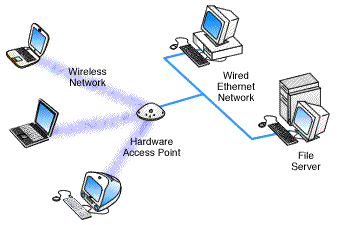
An access point allows devices to connect to the wireless network without cables. A wireless network makes it easy to bring new devices online and provides flexible support to mobile workers.
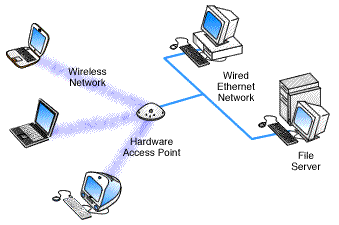


An access point acts like an amplifier for your network. While a router provides the bandwidth, an access point extends that bandwidth so that the network can support many devices, and those devices can access the network from farther away.
But an access point does more than simply extend Wi-Fi. It can also give useful data about the devices on the network, provide proactive security, and serve many other practical purposes.
Access points support different IEEE standards. Each standard is an amendment that was ratified over time. The standards operate on varying frequencies, deliver different bandwidth, and support different numbers of channels.

Share:

Tracking System


What is Tracking System ???


Tracking System is a system used to monitor the data of objects on the go. It is becoming an important tool for industries that want real-time information about their fleet, personnel or merchandise. The system enables the business to run smoothly and effectively. Many oil and gas companies and various other organizations are installing the system as it leads to potential savings on running costs. An ideal system constantly updates the target’s location, elevation, and range.


Types  of  Tracking System ??

Companies are finding location-tracking technologies ideal for better managing inventories or fleets of vehicles. Knowing the exact location of each piece of inventory helps to control the supply chain and saves money by not losing those assets that are in transit. Companies, such as retailers, must consider how to track inventory across a wide area, either country or state, and in a smaller area, such as the warehouse or store.

  • Wide-Area Tracking


On a large scale, companies must track their vehicle fleets across the country or the world. GPS is the ideal tracking technology for tracking over large areas. To do this, every vehicle needs to be equipped with a GPS receiver. As the vehicle crosses the country, the GPS satellites track the truck's position. With GPS, the operator can request positioning at anytime. However, GPS is limited in smaller areas or indoors.

  • Local-Area and Indoor Tracking

A good example of where GPS would not be suitable for tracking items is in a warehouse or hospitals. The accuracy provided by GPS is not sufficient for such a small scale. Consider all of the medical equipment, wheelchairs, gurneys and even patients that need to be tracked. GPS is not a practical or cost-effective solution.
For smaller areas, companies and healthcare organizations would likely use a network of RFID tags and readers to monitor the location of assets or inventory. A wireless LAN also would be more suitable. In such a system, each asset would be tagged with an RFID tag, and readers would be placed in strategic locations to be able to accurately read those tags within a matter of inches. A hospital worker would be able to find the exact room a wheelchair is located and retailers would be able to locate an item on any given shelf.
Another example of how this technology is already being deployed is in tracking children in some amusement parks. A child can wear a wristband with an embedded RFID tag. Park staff can track that tag through location receivers positioned around the park. One system in use at Legoland in Denmark even allows for the tag identification number to be registered with the parents' mobile phone.
Location tracking isn't limited to just allowing an organization to know where its assets are, these technologies also will help retailers and marketers find you to better target their key markets. In the next section you will learn about location-based services being deployed by wireless service providers

What is GPS Vehicle Tracking System ???


The GPS is a "constellation" of 24 well-spaced satellites that orbit the Earth and make it possible for people with ground receivers to pinpoint their geographic location. The location accuracy is anywhere from 100 to 10 meters for most equipment. Accuracy can be pinpointed to within one meter with special military-approved equipment. GPS equipment is widely used in science and has now become sufficiently low-cost so that almost anyone can own a GPS and many do in a smartphone, tablet or GPS navigation device.


GPS tracking is invaluable for police, firefighters, military personnel and large courier businesses. Many of these use automatic vehicle locator (AVL) systems. AVL systems generally include a network of vehicles that are each equipped with a mobile radio receiver, a GPS receiver, a GPS modem and a GPS antenna. This network connects with a base radio consisting of a PC computer station as well as a GPS receiver and interface. GPS uses interactive maps rather than static map images on the Web. AVL systems can be used to increase the accountability of field personnel and boost the efficiency of a company's dispatching procedure through tracking and communication.


Other GPS tracking technologies include GPS guns that law enforcement can fire at a fleeing car, avoiding a dangerous pursuit. In some places, law enforcement representatives also use GPS dust, which consists of GPS trackers so small they might be blown or rubbed on a target’s clothing.

GPS devices in smartphones and other mobile devices are often used to track employee location.  Privacy advocates warn that the technology can also make it possible for advertisers, government, hackers and cyberstalkers to track users through their mobile devices.

Share:

Home Automation System

What is Home Automation System ???


Home automation system makes the operations of various home appliances more convenient and saves energy. With the energy saving concept, home automation or building automation makes life very simple nowadays. 

It involves automatic controlling of all electrical or electronic devices in homes or even remotely through wireless communication. Centralized control of lighting equipments, air conditioning and heating, audio/video systems, security systems, kitchen appliances and all other equipments used in home systems is possible with this system. 


Home Automation System

This system is mainly implemented by sensors, controlling devices and actuators as shown in the figure. The sensors detects light, motion, temperature and other sensing elements, and then send that data to the main controlling devices. 

These sensors can be thermocouples or thermistors, photo detectors, level sensors, pressure sensors, current transformers, IR sensors, etc., which need an additional signal conditioning equipment to communicate with the main controller.

Controllers may be personal computers/laptops, touch pads, smart phones, etc., attached to the controlling devices like programmable-logic controllers that receive the information from the sensors, and based on the program, control the actuators. 

This program can be modified based on the load operations. The programmable controller allows to connect various sensors and actuators through various input and output modules whether they are analog or digital.

Actuators are the final controlling devices like limit switches, relays, motors and other controlling mechanisms which finally control the home equipments. 

Communication plays an important role in this home automation system for the remote access of these operations. This smart home system also provides continuous monitoring through video surveillance with cameras, scheduling, and energy saving operations. This is the best solution even for the elderly and the disabled persons to operate equipments.


Types of Home Automation Systems : 


Implementation of the home automation depends on the type of controls like wired or wireless. There are mainly three types of home automation systems
  1.     Power line Based Home Automation
  2.     Wired or BUS Cable Home Automation
  3.     Wireless Home Automation

1. Power Line Home Automation System


This automation is inexpensive and doesn’t require additional cables to transfer the information, but uses existing power lines to transfer the data. However, this system involves a large complexity and necessitates additional converter circuits and devices.

2. Wired Home Automation System


In this type of automation, all the home equipments are connected to a main controller (programmable logic controller) through a communication cable. The equipment is attached with actuators to communicate with the main controller. The entire operations are centralized by the computer that continuously communicates with the main controller.
3. Wireless Home Automation


This is the expansion and advancement of wired automation which uses wireless technologies like IR, Zigbee, Wi-Fi, GSM, Bluetooth, etc., for achieving remote operation. As an example, the GSM based home automation provides the controlling of home equipments by an SMS to the GSM modem.


How Does Home Automation System Works ???


Home automation systems offer options to help you create the life you want. Below are seven ways these systems work to make your life easier:

1. Automate your lighting

Smart lighting systems enable you to quickly set the mood whether you're having guests over or are just spending the night alone. Aside from being able to adjust the color of the lights, you can also control them from your smartphone. You'll never have to worry about accidentally leaving your lights on overnight again.

2. Give guests remote entry into your home

Whether you're throwing a neighborhood party or having a small get-together, always dropping everything to answer the door is never fun. Fortunately, you can end this pain by using a smart lock and doorbell camera. These technologies enable you to see who's at your door when they arrive. From there, you can communicate with them and unlock the doors for them if you choose. You can also provide guests with single-use virtual keys so they can let themselves in when they arrive.

3. Automate climate controls for comfort and savings

Modern smart thermostats are much more robust than traditional ones. Smart home automation systems are designed to fit your lifestyle with smartphone controls, timed settings and even artificial intelligence that tracks your daily routines then auto-adjusts to save energy while optimizing comfort. 

4. Protect your home and family from crime

One of the biggest benefits of home automation technology is the supported security integration. When you combine an alarm system with smart locks, window sensors, and security cameras, you'll have peace of mind that the home is secure. These systems can be set to automatically arm themselves when you leave, and send alerts if you forget to lock up. Additionally, when combined with smart locks, you'll be able to lock your doors with your smartphone.

5. Keep an eye on the kids while you're out

Many parents hesitate to give their children smart phones until they reach a certain age. Wireless indoor cameras with built-in two-way communication systems so you can keep an eye on the kids and communicate with them without giving them a  smartphone. 

6. Share photos and videos between family members

With video recording services like Playback and hardware like Smart Drive, it's easy for your entire family to automatically backup their photos, videos, and files into a secure, central hub fully controlled within the home. 

7. Gain a personal assistant

Voice-activated smart home devices, like Amazon Echo, enable you to control your entire home with your voice. You're in charge of the garage doors, locks, arm your system and adjust thermostats and lights. In addition to managing your home,


Share:

RFID Technology


What is RFID Technology ????


RFID stands for Radio Frequency Identification. RFID technology makes use of electromagnetic waves to capture and read data. The information is electronically stored on a tag that is attached to an object or the carrier. The tags can be detected from several feet away by the receiver.
RFID technology is popularly employed in access control systems to allow entry of authentic and authorized personnel only. 
RFID technology has application in several areas such as:
  • Identification of personnel
  • Access based security systems
  • Parking facilities including gate control
  • Tracking of consumer goods 

RFID in Access Control Management System

The most common use of RFID is in access control and door entry systems for personnel. The basic principle upon which RFID tags are employed is the identification badge of the workers of any company or industry. The RFID applications for personnel identification uses normally quite low frequency, almost 140 KHz, for badge detection.


Let’s take a deeper dive to understand how RFID technology works in the access control systems. RFID system is composed of the following main components:
  • The RFID Card or Tag
    RFID Tag
  • The RFID Reader 
    RFID Reader
  • Card Access Management Software
  • Access Control Panel

RFID tags are used in many industries. For example, an RFID tag attached to an 
automobile during production can be used to track its progress through the assembly line; RFID-tagged pharmaceuticals can be tracked through warehouses; and implanting RFID microchips in livestock and pets enables positive identification of animals.

RFID Card / Tag

The information of person, object or the carrier is electronically stored in the RFID cards/tags. The RFID card/tag can contain only small piece of information such as identification number, price or code.

RFID Door Reader

The RFID reader has an antenna which sends the radio waves to detect any RFID tag or card within its range. This range can vary for the RFID readers depending upon the frequency of emitted radio waves.The RFID reader decodes the uniquely stored information in the RFID card/tag and sends the signal to the host software.
How Does RFID Works ???


RFID belongs to a group of technologies referred to as Automatic Identification and Data Capture (AIDC). AIDC methods automatically identify objects, collect data about them, and enter those data directly into computer systems with little or no human intervention. RFID methods utilize radio waves to accomplish this. At a simple level, RFID systems consist of three components: an RFID tag or smart label, an RFID reader, and an antenna. RFID tags contain an integrated circuit and an antenna, which are used to transmit data to the RFID reader (also called an interrogator). The reader then converts the radio waves to a more usable form of data. Information collected from the tags is then transferred through a communications interface to a host computer system, where the data can be stored in a database and analyzed at a later time.


Two Types of RFID Systems:


·        Active RFID system: These are systems where the tag has its own power source like any external power supply unit or a battery. The only constraint being the life time of the power devices. These systems can be used for larger distances and to track high value goods like vehicles.

·        Passive RFID system: These are systems where the tag gets power through the transfer of power from a reader antenna to the tag antenna. They are used for short range transmission.


What is RFID Reader Technology ???


A radio frequency identification reader (RFID reader) is a device used to gather information from an RFID tag, which is used to track individual objects. Radio waves are used to transfer data from the tag to a reader.

RFID is a technology similar in theory to bar codes. However, the RFID tag does not have to be scanned directly, nor does it require line-of-sight to a reader. The RFID tag it must be within the range of an RFID reader, which ranges from 3 to 300 feet, in order to be read. RFID technology allows several items to be quickly scanned and enables fast identification of a particular product, even when it is surrounded by several other items.

RFID tags have not replaced bar codes because of their cost and the need to individually identify every item.


RFID technology may be used in a variety of applications including:

  • Passports
  • Smart cards
  • Airplane luggage
  • Toll booth passes
  • Home appliances
  • Merchandise tags
  • Animal and pet tags
  • Automobile key-and-lock
  • Monitoring heart patients
  • Pallet tracking for inventory
  • Telephone and computer networks
  • Operation of spacecraft and satellites
RFID technology uses digital data in an RFID tag, which is made up of integrated circuits containing a tiny antenna for transferring information to an RFID transceiver.

How Does RFID Reader Works ???


Share:

Other Post

Pageviews

Search This Blog

Blog Archive

Powered by Blogger.

CCTV Camera

Translate

NEC SL 2100 EPABX

Inquiry Form

Name

Email *

Message *

Pages

Support

Any Query about product & Service Contact & Email me.